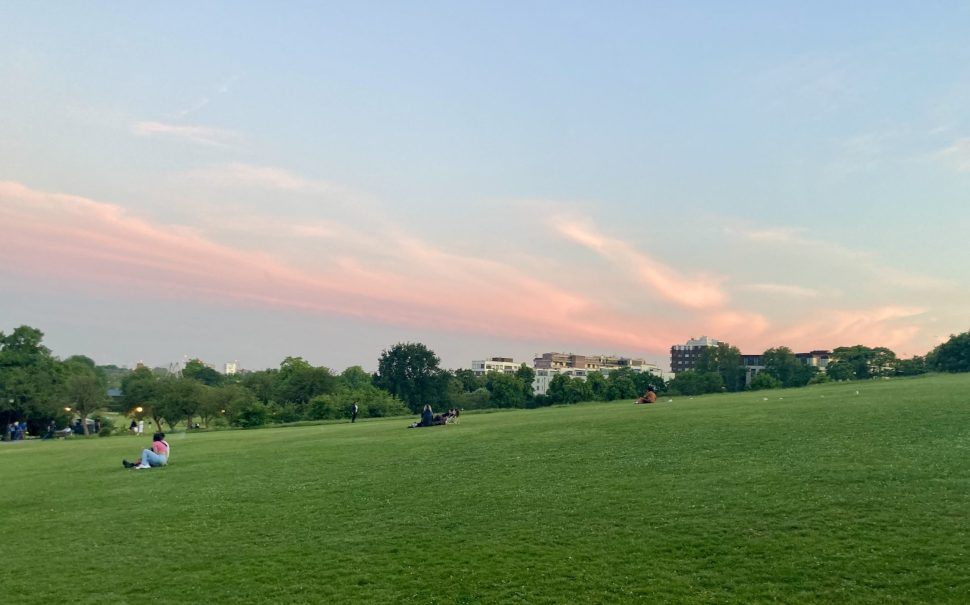
In some London boroughs, less than half the population lives more than a 15-minute walk from nature, according to data from the Department for Environment, Food & Rural Affairs (Defra).
London as a whole performs just under 10% lower than the national average for accessibility to green and blue spaces, and within London, huge disparities exist – while nearly all Hackney residents live near a public park, garden, nature reserve or body of water, just over a third of Harrow residents do.
The benefits of living close to nature are extensive and well-documented, which is why the government committed to ensuring everyone lives within walking distance to nature as part of their Environmental Improvement Plan (EIP) 2025.
Amelia Claridge, a nature recovery programme officer for the London Wildlife Trust, explained why these spaces are so valuable.
She said: “We must save and improve blue and green spaces. It’s important for climate crises, important for biodiversity crises, and it’s important for people.”
“People find it very relaxing to be around nature. It’s a little oasis in the middle of the city for people to hang out with friends.
“It’s a good third space for a lot of people. It’s also a place to exercise, so it promotes an active lifestyle as well.
“Lots of green spaces have seen groups called ‘Friends of…’ groups associated with them. So it really can encourage community cohesion.”
And, as green spaces also offer means for more efficient urban cooling, residents with more green space are also equipped with stronger protection against rapidly rising temperatures in the capital.
In fact, the benefits of nature are so significant that Natural England estimates that the NHS could save an additional £2.1 billion a year if everyone had good access.
Schemes across London are underway to try to ensure these benefits are felt by all Londoners, not the lucky few.
According to Natural England, only 26% of people living in the most socially deprived areas have a green space nearby, compared to 38% in the least deprived areas.
West London, which experiences some of the highest rates of wealth inequality in the capital, also ranks the lowest in terms of access. Black, Asian and minority ethnic groups are also more likely to experience the ‘green-gap’.
With the benefits of natural spaces so high, and the disparity in who gets to experience it higher still, Londoners are left living in a nature-based postcode lottery.
Calum Medlock, a Harrow resident, described his frustrations with living in a borough so wanting of green spaces. And while access to nature is low, the quality of the parks is also a key issue, he explained.
He said: “I think it affects people more than they realise, especially mentally.
“If spaces already feel neglected or low priority, people can start treating them with less respect, which then makes the problem worse. But equally, when an area visibly feels cared for, cleaner and properly maintained, I think people are more likely to value it and look after it themselves.
“When public spaces feel neglected, overcrowded or constantly littered, you stop feeling relaxed in your own environment. Even simple things like walking my dogs can become stressful rather than enjoyable.
“If I actually want to spend time in proper nature or somewhere that feels greener and more peaceful, I’d usually need to take a bus or travel outside the immediate area, which kind of defeats the point of having accessible green space nearby.”
While some areas of London strain to make momentum towards government targets, new development plans threaten to regress some boroughs even further. More than 50 of the city’s parks are at risk from development, including in Waltham Forest and Sutton, where swathes of residents already live out of reach of any green space.
Claridge of the London Wildlife Trust said: “It’s hard because London has a growing population and we do need affordable housing.
“Lots of councils are under a lot of pressure to deliver affordable housing. So there’s huge conflicts for bits of land. Development plans must be made in conjunction with recovery efforts.”
Kidbrooke Village is a thriving example of nature and development working in symbiosis. From the start of the planning process, green and blue spaces were woven into the design.
Now both local biodiversity and the local community have flourished and, once it is finished, Kidbrooke is expected to achieve a 200% gain in biodiversity.
On a smaller scale, pocket parks and green roofs have shown promise by offering a few square metres of greenery amongst urban areas that struggle to find space for larger plots of nature.
Government efforts to scale up and protect green spaces are gathering momentum. Along with the government’s EIP 15-minute commitment, the Green Spaces Bill is also making its way through Parliament, which hopes to establish a Government Office for Green Spaces to preserve and enhance natural environments.
And last year the Mayor of London, Sir Sadiq Khan, announced a £12 million investment via a new Green Roots Fund (2025-2028) to create and improve London’s green and blue spaces.
Claridge emphasised the need for local and national government efforts to come to fruition, adding: “Everyone deserves access”.
Featured image credit: Roxana Diba

Join the discussion