Hackney Council’s temporary housing costs more than tripled between 2021/22 and 2024/2025 from £6.2million to £20.6million, official data has shown.
While costs in 2025/2026 were less at £15.7million, Hackney still spent more on temporary housing in January 2026 alone than it did for the entirety of 2022/23.
This is true across London – the average cost of temporary housing has risen 75% over the last five years, according to London Councils.
The question – why?
What is temporary housing?
Temporary housing is accommodation used while waiting for social housing to become available.
Temporary housing is privately owned, meaning the council rents it directly from landlords, estate agents, or hostels and hotels.
A person living in temporary accommodation is considered homeless and as much as 210,000 Londoners live in temporary housing, or 1 in 50 – 50% more households than a decade before.
At 3,400, Hackney has the 5th highest proportion of households in temporary accommodation in London, at 28 in every thousand.
The time people stay in temporary accommodation has grown too, lasting years rather than months – over five in some cases.
Why are costs going up?
In short – supply is falling behind demand, and it is increasingly profitable for private businesses to fill in the gaps.
In London there are currently 341,421 households on the waiting list for social housing, a ten year high.
This is in part because there are simply less council homes.
Right to Buy (RtB), introduced in 1980, allowed tenants of social housing to buy the property they lived in at a discount, with councils using the proceeds to build new social housing – a one-for-one exchange.
However, it proved unfeasible to replace each home bought and the number of council homes in London has fallen since 1980 from 715,000 to 390,000 in 2024.
Hackney has sold 10,000 properties since RtB was introduced and as of 2017 40% of RtB homes were being privately rented.
Likewise, a freedom of information request showed that between 2010-2022 Hackney Council sold twice as many houses as it built.
As available housing has fallen, the cost of maintaining existing housing has risen.
Much of London’s social housing stock was built in the 1960s and 70s and is predominantly made up of flats, which are more expensive to maintain.
The age of the buildings brings numerous, expensive problems, not least of which is damp and mould.
Hackney Council, who make 90,000 repairs a year, were found in a 2025 ombudsman investigation to have 1,400 open damp and mould cases, 600 severe and 500 overdue.
The expense and lack of social housing means more and more are placed in temporary housing – an arrangement expensive for councils and profitable for others.
Rock and a hard place
Councils are between a rock and hard place.
The need for temporary accommodation has led to a seller’s market – councils have little choice other than accept inflated prices, costly alternatives, and lower standards.
Increasingly there is nowhere to home people other than pay for nightly accommodation such as hostels, which are far more costly over time than agreed rents.
As such, between 2021 and 2023 net council spending on nightly housing tripled from £55million to £157million, almost a third of total temporary housing expenditure.
The other two thirds is mostly made up paying landlords and estate agents to rent properties for long periods.
These rentals are often managed by large firms that lease properties to the council under ‘guaranteed rent’ – they pay the owner of a property a guaranteed amount each month and then rent the property at an increased price, keeping the cut in between.
One guaranteed rent property manager, Elliot Leigh, for example was paid over £540,000 by Hackney Council in January 2026.
Besides high prices and low supply properties used by councils for temporary housing fall below standards – suffering from damp, mould, lack of heating, and overcrowding.
A report made by the House of Commons and the charity Shelter found that 75% of residents in temporary households were in poor condition, and 20% had a safety risk.
Of the 160,000 children living in temporary accommodation in England in 2025, 74 died.
Much of the damage to health, mental and physical, of sub-standard temporary homes is long-term – anxiety, respiratory illness, malnutrition.
The damage to Londoners is long-term as well.
Increasing pressure pushes more into homelessness, poverty, and ill-health at greater cost to local government.
As this pressure builds, it won’t only affect the people in need of homes – 11% of your council tax is already spent on it.
–
When Hackey Council was asked to comment, Councillor Abi Kingston, Deputy Cabinet Member for Homelessness Prevention and Temporary Accommodation, said: “This is a drastic increase.
“This sad reality is that successive governments have made political choices that have pushed many residents into poverty, in Hackney and across the country, while house prices and rent have spiralled.
“This housing crisis is about affordability, and will only be solved by significant investment in housing by the national government.
“We now provide temporary accommodation for nearly 3,800 households, with thousands of families approaching the council as homeless last year. Meanwhile the cost of securing properties increases.
“As a new administration, we’re determined to bring more temporary accommodation in-house to reduce costs and improve standards, while delivering more genuinely affordable homes in Hackney.
“But we need the national government to match our ambition and invest to fix a housing scandal that lets landlords and developers profit while leaving too many families and individuals without a stable, affordable home.”
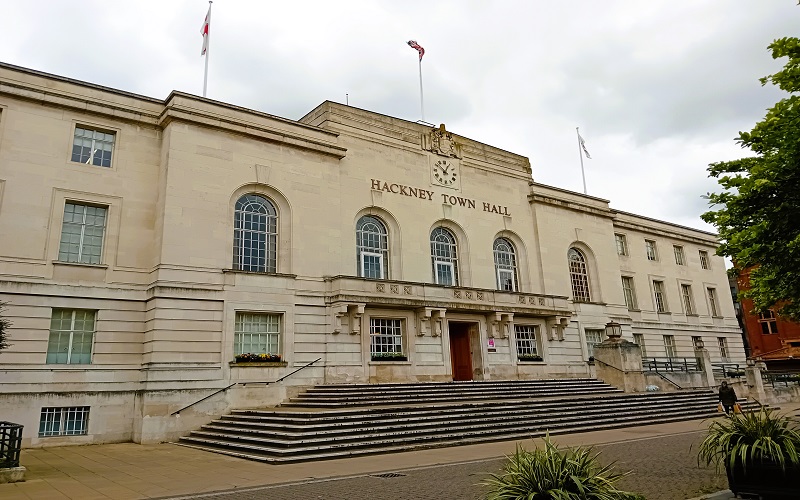
Featured Image: Hackney Town Hall. Credit: Richard Kelly, CC BY 4.0, via Wikimedia Commons


Join the discussion