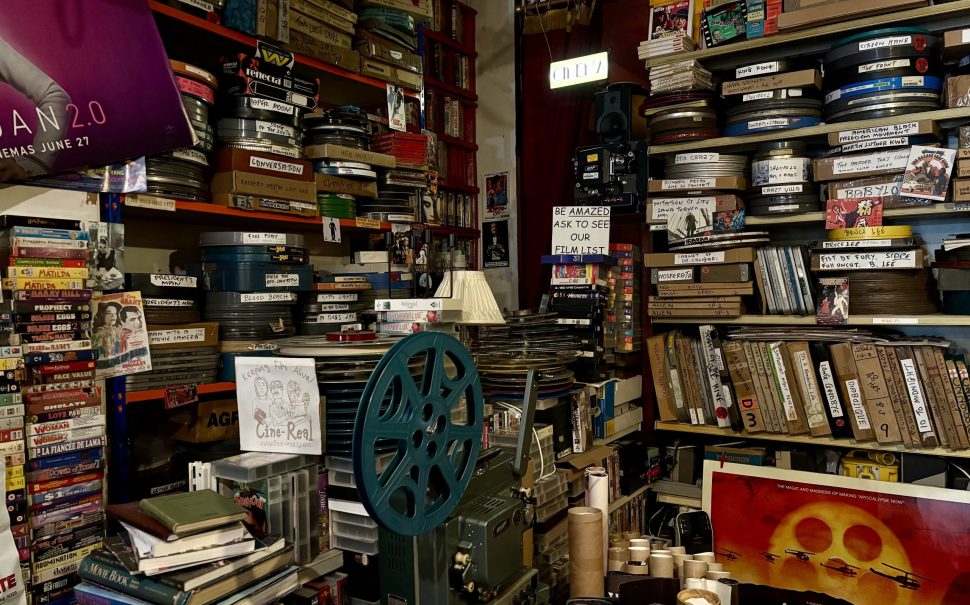
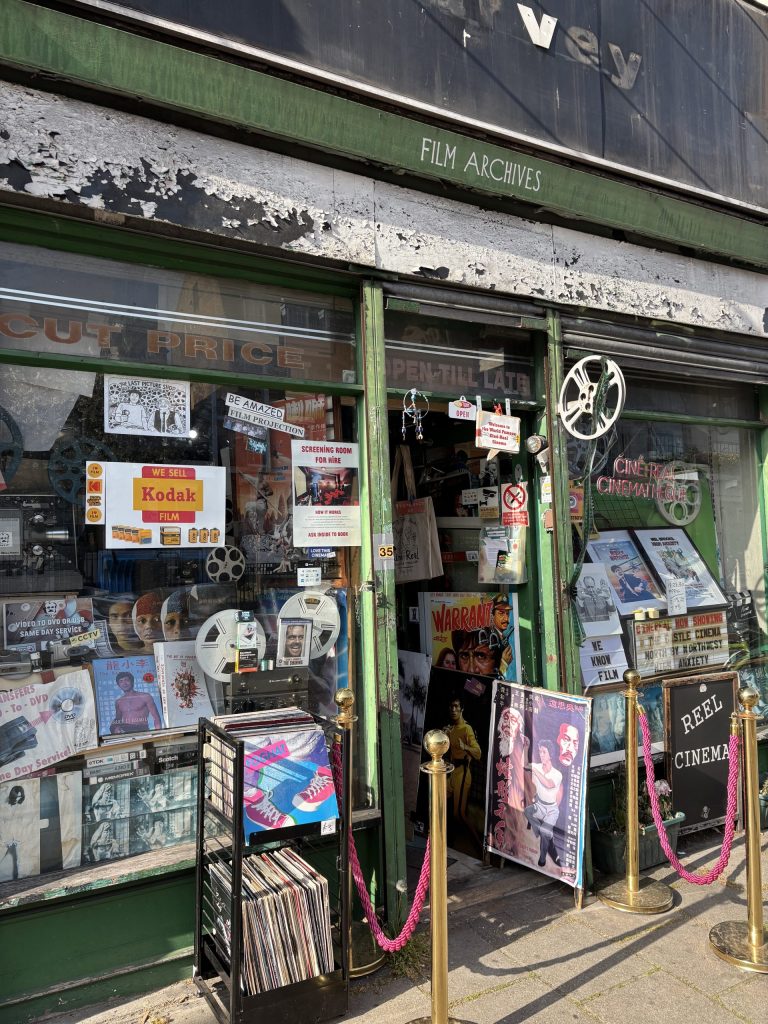
Shoehorned between a late night burger joint and a disused leisure centre in east London sits Ümit & Son, the last cine film shop in the UK.
Last year, filmmaker Liam Saint-Pierre began filming a feature-length documentary about the shop’s owner, projectionist Ümit Mesut, a 65-year-old Cypriot Cockney, and his attempt to enlist analogue purist Quentin Tarantino to help save his shop from closure.
Ümit’s tiny shop is stacked floor to ceiling with reels, VHS tapes, film posters and cassettes – a slim path is left between, just wide enough to navigate through to the 15-seat screening room at the back. For 40 years he has been a fervent warden of an analogue art form that is being rapidly replaced by digital processes.
But Ümit’s shop faces threats beyond just waning interest in celluloid. “It was around after the pandemic, the shop was starting to really struggle. Business rates had gone up a lot, rent had gone up, gentrification. He was really struggling,” Liam said.
When Liam started making a film about saving the shop, Ümit’s brother, BJ Mesut, suggested Tarantino – who like Ümit, loves film, used to work in a video shop, and shoots exclusively on celluloid – might be the person to help them.
Tarantino, who once referred to digital film as the ‘death of cinema as I know it‘, could be the saviour of the film shop.

An unlikely friendship
Ümit and Liam’s friendship began when Liam, who is 47, took an old super 8 projector he had found in a bin to Ümit for repair. Ümit upsold him a more expensive one and so began a now 15-year long friendship which has thrived through their shared passion for film.
Liam said: “He’s the person I speak to the most, I’ll speak to him about three or four times a day.”
Although Ümit initially resisted, the two began putting on film nights, projecting classic movies to small groups, which eventually turned into Ciné Real – a weekly film club playing 16mm projections at the Castle Cinema in Clapton.
Liam created a short film about Ümit in 2013, ‘The Way of the Dodo’, winning the award for Best Short Documentary at the Barcelona Film Festival and triggering a career change for the former NHS physiotherapist.
In this longer documentary based on Ümit and his shop, the two travelled to Los Angeles in search of the Hollywood director. “We had two weeks of trying to track down Tarantino, so we had a real adventure,” Liam said.
Ümit, who rarely leaves the square mile he occupies in Hackney, had two rules for their trip: One, they could only go for two weeks. Two, it couldn’t be shot on any of that ‘digital crap’, as he calls it.
Keeping analogue alive
But shooting on analogue rather than ‘digital crap’ has its obstacles. Besides being far more expensive than digital, one roll of film is roughly 11 minutes worth of footage and you can’t watch it back – so, if the lighting is wrong, the whole reel is spoiled.
Despite the difficulties, Liam maintains his passion for 16mm. “What I love about film is even the mistakes on the whole can look really good, and the footage does look beautiful,” he said.
“We’re just trying to keep that alive and that experience. It’s definitely got its flaws, but I think that’s what adds character.
“It’s like sitting in front of a radiator versus sitting in front of an open fire. There’s something so primitive about what we connect to, the sense of it being alive.”
The Kickstarter campaign, which goes towards producing the second half of the film and eventually building a small film archive and micro cinema in the back of Ümit & Son, finished in April having raised £55,000, surmounting the original goal by £25,000 – thanks in part to a professor at the University of Nevada who came in at the last minute with £8,000.
The campaign’s success is a testament to the love that celluloid holds on people. Liam describes it as a way of “slowing down or connecting to something more physical, that you don’t get with digital”.
While digitally produced films continue to dominate over analogue, over 90% of major studio productions were digitally-produced in 2026, there seems to be a slight creep back towards celluloid. Half of the best picture nominees at the 2026 Academy Awards were shot on 65mm and 35mm.
Finding Tarantino
Although they never find Tarantino, Liam explains the film’s meaning goes far beyond that search. “He’s the MacGuffin,” he said. In cinema, a MacGuffin is the object or goal that drives the protagonist’s journey, the thing that sets the story in motion.
“For us, he was the thing that took us to Hollywood. But what we realised there is we had to go on that journey to understand we had it all along, back in the shop community.”
Featured image credit: Roxana Diba



Join the discussion