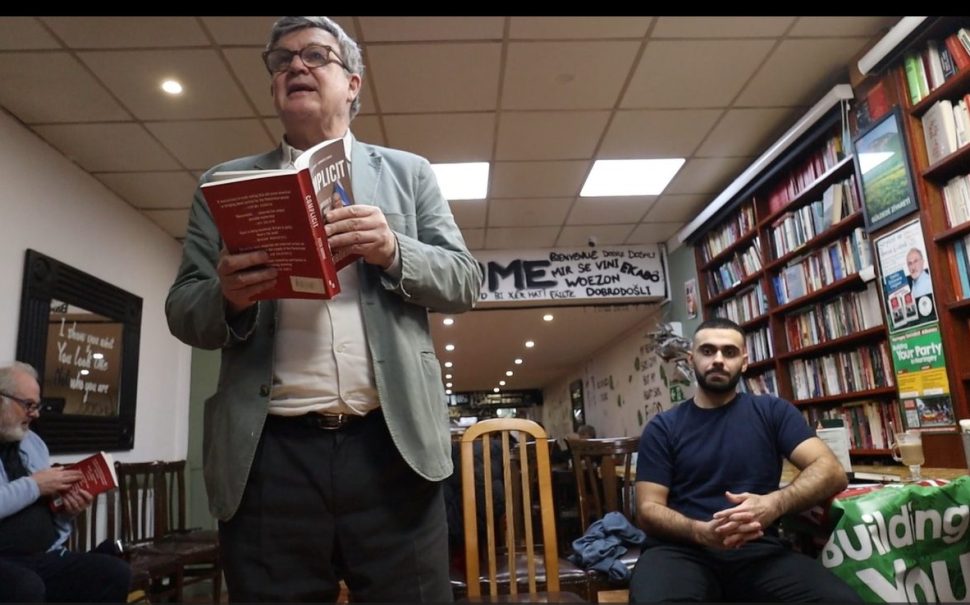
Journalist Peter Oborne’s new book on Britain’s role in the Gaza war placed him at the centre of an ongoing row over how the conflict has been reported on by the British press.
On 23 January, Oborne appeared at The Garden House Café Bar & Restaurant for a reading, discussion and Q&A on his book Complicit: Britain’s Role in the Destruction of Gaza, hosted by campaign group Haringey PALs and was joined on by Journalist Hamza Yusuf.
Complicit, published by OR Books, is now a Sunday Times bestseller. In it, Oborne argues that Britain’s Conservative and Labour parties converged in backing Israel’s military campaign in Gaza, and that much of the British media failed to challenge that political consensus rather than scrutinise it.
The book draws on original reporting to trace what Oborne presents as a chain of responsibility running from Westminster through to the newsrooms that covered the war.
The books targeting of journalism is not incidental. Oborne was chief political commentator at The Daily Telegraph until his resignation in 2015, when he said commercial pressures had influenced the paper’s editorial decisions.
He has since written for the Middle East Eye, Byline Times and Declassified UK, and authored several previous books on political conduct and the media, including The Rise of Political Lying and the Sunday Times bestseller The Assault on Truth.
In Complicit, he applies that scrutiny to coverage of Gaza, arguing British broadcasters and newspapers have too often reported the conflict on the terms set by British and Israeli officials rather than holding those narratives to account.
Central to his case is the language used to describe violence against Israeli civilians, which is typically described in more direct terms by British outlets than in contrast to violence against Palestinian civilians. He believes this is how audiences assign blame and sympathy for events they cannot witness firsthand.
Oborne’s argument echoes research published by the Centre for Media Monitoring (CfMM), Its analysis of television coverage in the early months of the war found that Palestinian voices appeared less often than Israeli ones, and that Palestinian civilian deaths were often reported with less detail or attribution than Israeli deaths.
Backers of that research say it points to a structural pattern across outlets, built up through repeated choices on wording, sourcing and prominence, rather than any single deliberate act of bias by an individual editor or reporter.
They argue that even small, cumulative differences in how coverage is framed can shape public understanding of who bears responsibility for a conflict.
Journalists and media academics argue that comparing coverage this way overlooks the practical conditions of reporting an active war.
Access to Israeli officials and spokespeople has generally been significantly easier than access to Gaza, where foreign correspondents have faced tight restrictions on entry throughout the conflict.
The BBC, one of the outlets most frequently criticised by Oborne, has repeatedly denied systemic bias, citing its editorial guidelines on due impartiality and accuracy, and pointing to extensive coverage of Palestinian civilian suffering alongside reporting on Israeli victims and hostages.
Other UK broadcasters and newspapers have made similar arguments, the legal and ethical constraints around reporting claims made by parties to an armed conflict, and the difficulty of verifying casualty figures in real time.
Researchers who study audience behaviour pointed out the “hostile media effect” a well-documented tendency for people with strong views on an issue to perceive neutral coverage as biased against their own side.
That doesn’t resolve whether Oborne or the CfMM are correct about UK coverage of Gaza, even as both sides advocate with detailed content analysis to support their positions.
Haringey PALs hosting Oborne highlights a high-profile journalist willing to publicly indict his own profession over its handling of one of the defining foreign policy issues of the decade.
The format of reading, discussion, and open Q&A in a community venue has become typical of how Complicit is being introduced to audiences that are attracted tot the topic.
The questions raised are the same ones being debated in newsrooms, regulators and academic departments nationally. How should broadcasters weigh competing claims from parties to a conflict, how loaded terms such as “terrorist,” “occupation” and “genocide” should be handled and whether constant scrutiny on social media is improving standards.
In summary, Oborne questions British journalism and how it has largely failed that test over reporting on Gaza. It questions genuine institutional bias and the inherent difficulty of reporting a war.
Complicit: Britain’s Role in the Destruction of Gaza is published by OR Books and available now.
Feature image courtesy of Taaseen Choudhury, with thanks

Join the discussion