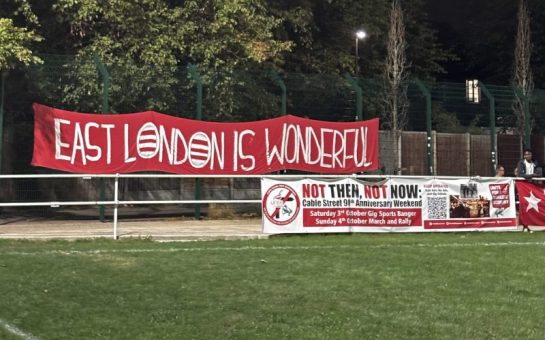
Thousands of people have gathered in East London to mark 90 years since communities came together to stop a fascist march in a clash that became known as the Battle of Cable Street.
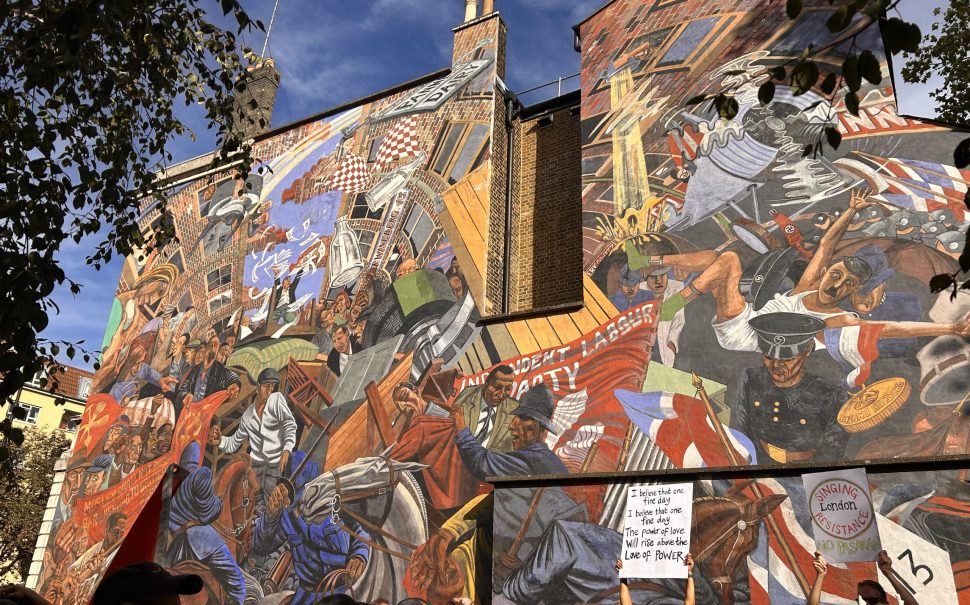
The anniversary event started at Tower Hamlets Town Hall in Whitechapel, before demonstrators marched to Cable Street, ending at St George’s Garden by a 15-metre-tall mural that commemorates the clashes.
On 4 October 1936 Oswald Mosely’s British Union of Fascists (BUF) planned to march through an area of the city which had a large Jewish population. The BUF march was seen as a deliberate provocation as the group openly promoted antisemitic views. Thousands of people came together to block the route, leading to clashes with police as they tried to prevent the march from going ahead.
Former Labour leader Jeremy Corbyn and children’s author Michael Rosen were among those who spoke at Sunday’s 90th anniversary march.
They joined union leaders and activists calling for a united front against racism and economic inequality.
Corbyn said: “It’s very important to understand what went on here.
“Anti-racism means we opposed every form of racism, wherever it raises its head. It destroys the unity that we need to improve living standards among the poorest people in society.”
Trade unions also attended the demonstration, with UNITE union general secretary Sharon Graham using her speech to call attention to the fact that many of those opposing the BUF in the 1930s belonged to left-wing groups.
Kwabena Nyack, 70, attended the march representing Caribbean Labour Solidarity.
He said: “It’s important to memorialise working class events in our history.
“Irish people, Jewish people, and the white working class came together that day to defeat the fascists that were trying to divide us.”
Children’s author and activist Michael Rosen said he hopes the commemorations mean more young people will remember the Battle of Cable Street.
Rosen said: “Children have to study the Holocaust, which happened on the continent. It would be nice if they connected it with what could have happened here.”
Many activists on the march held signs bearing the Spanish anti-fascist slogan from the 1930s “No pasarán” meaning “they shall not pass”.
The rally also involved a sizable contingent of pro-Palestinian protestors, with some carrying signs with anti-Zionist slogans.
Before Rosen’s speech there was a small clash involving marchers and counter protesters carrying flags representing Campaign Against Antisemitism (CAA), who objected to the presence of anti-Zionist slogans at the rally.
CAA claimed the rally, which celebrated Londoners’ resistance to anti-Jewish violence, had been “hijacked”.
After the event, a spokesperson for CAA said: “Ninety years ago, brave Londoners recognised anti-Jewish racism and stood with their Jewish neighbours against it.
“Ninety years ago, they did not pass. Today, despite the efforts of a valiant few, they did.”
Featured image credit: Talisker Scott Hunter

Join the discussion