Children attending state schools in north east London are among the least likely to enter GCSE language subjects, with new data highlighting stark inequalities between boroughs.
Barking and Dagenham ranks last in Department for Education (DfE) figures from 2024/25, showing how many pupils in London entered GCSE language subjects, with 45% – nearly a third lower than top-scoring Westminster at 73%.
The numbers show a large disparity between neighbouring boroughs – Waltham Forest recorded a little over half of its pupils took a language, whilst in Newham this figure was 69%, and in Hackney it was 71%.
Comparing DfE figures from 2024/25 and 2018/19, the last academic year to be unaffected by the pandemic, shows negligible change in Barking and Dagenham, whilst Waltham Forest dropped by nearly 8%.
This data shows children in Barking and Dagenham were also the least likely to enter a GCSE language subject in 2023/24, with Waltham Forest placing last the year before.
Whilst studying Modern Foreign Languages (MFL) to age 16 was mandatory in English schools until 2004, the priority placed on these subjects is now at the discretion of individual schools.
Since 2010, the English Baccalaureate (EBacc) has measured secondary schools on how many of their students take exams in five core areas of study – English, Maths, Science, Humanities and Languages – and their performance in these subjects.
The government announced this month that the EBacc will be scrapped, amidst falling A-Level rates and a 20% decline in undergraduates enrolling in language courses, citing its failure to encourage uptake.
Adam Lamb, director of MFL at United Learning, a group of state and fee-paying English schools, felt removing this incentive could give some headteachers permission to cut languages.
Lamb, who formerly worked in a top-performing Hackney state school where languages were treated as non-negotiable, said: “I don’t think the schools that value the importance of studying a language will change their curriculum.
“It’s those that are on the edge, fighting for results, maybe with too much of a focus on English and Maths, that will cut them from their diet.”
A research study published by the University of Cambridge in October found that poorer students are disproportionately concentrated in schools where learning a language to GCSE is treated as optional, and not necessarily encouraged.
With fewer students attending universities to study languages, and difficulty in recruiting teachers from Europe due to visa issues following Brexit, Lamb believed reducing the amount of pupils in MFL subjects was an easy option for struggling schools.
He continued: “Some schools, especially if they’re looking at the Grade 4-plus view of languages, you want your rating as close to 100 percent as possible.
“So if you’ve got a student that’s going to get a 1 or a 2 you’re more than likely not going to enter them.”
There is a 26% disparity in pass marks between Richmond upon Thames, which despite a comparatively low entry rate into languages ranks first for results, and Croydon with its pass rate of just under 64%.
Five of the seven boroughs traditionally recognised to be in north east London are placed in the bottom half of the list.
David Blow, a fellow of the Association for Language Learning (ALL), a charity supporting language teachers, said: “There’s a fundamental issue about the severe grading of GCSE languages, which is a real tragedy.
“Pupils will compare their grades in languages to other subjects and it will be a grade lower.
“Schools are very much driven by Ofsted, there’s a harsh reality. If you don’t get a good Ofsted grade then parents vote with their feet, especially in London where there’s so much choice.”
Blow highlighted anxieties in the teaching community that with the scrapping of the EBacc and it is unclear whether MFL is still regarded as an integral part of a key stage 4 curriculum.
Megan Bowler, author of a Higher Education Policy Institute report about the decline in language learning, highlighted only 43% of the government’s MFL teacher recruitment target was met in 2024.
Bowler argues this has the biggest impact on children in disadvantaged areas.
She said: “Languages are very good for communication and oracy in general. These are skills that are being emphasised a lot at the moment as the key to social mobility.
“With students from disadvantaged backgrounds, there’s often a greater pressure to take subjects that are perceived as useful, with an emphasis on STEM subjects and away from languages and humanities.”
According to DfE data, the number of students in London taking A-Level subjects in Science, Technology, Engineering, and Maths has risen by 3.3% since 2020/21, to 55.4% in the last academic year.
The number of A-Level language students in London stood at 7.4%, with a 1.4% decrease in the same period.
Helen Myers, a language teacher for over 40 years and chair of ALL’s London branch, said: “As a language teacher we feel we’re not on a level playing field with other subjects.”
She is heading a scheme called London: City of Languages to celebrate the 300 different languages spoken in its schools.
London has the highest rate of students studying GCSE language subjects across English regions, 16% higher than the national average.
The high number of students in the capital who are already bilingual, and initiatives undertaken by individual schools to promote languages, complicate simple conclusions about wealth inequality leading to fewer students studying MFL.
David Blow felt in London especially there are disadvantaged areas with aspirational schools and high levels of pupil progress.
Nathalie Blondeau, who teaches MFL in south London for the Harris Federation, which operates 31 non-selective secondary schools across the capital, said pursuing languages was compulsory in many of its academies, with Mandarin Chinese offered alongside traditional subjects.
Barking and Dagenham, Newham, and Hackney are among the ten most deprived local authority districts in England according to government data, but have contrasting rates of GCSE language entries.
Newham had the highest percentage of children (65%) entering at least one GCSE whose first language was not English in 2024/25, with DfE data showing that children who are already bilingual were more likely to enter a language subject in the vast majority of boroughs.
Barking and Dagenham and Hackney had comparable numbers, yet children in Hackney were far more likely to take an ‘other’ modern language subject, which a child will commonly be familiar with from speaking it at home.
In Hackney, 15% of students took a language other than French, Spanish or German 2024/25, the fourth-highest in London.
Barking and Dagenham ranked bottom with 4%, despite placing 19th out of 32 boroughs for the amount of GCSE pupils whose first language was not English.
Hackney undertakes an ambitious initiative in its schools to focus primarily on learning Spanish.
This approach led just under half of pupils in Hackney to enter GCSE Spanish in 2024/25, more than any other local authority in England.
Bernadette Clinton, senior language consultant for Hackney, said there was a ‘very rich language scene’ in the area, which she felt was not the same across every borough.
In her report, Bowler recommended greater recognition of languages which pupils speak at home in the classroom, making it easier to gain formal qualifications.
The benefits of learning a language run deeper than simply knowing how to speak it, they can help a child’s awareness of different cultures and promote empathy, she said.
Bowler added: “People increasingly think that we don’t need languages because Google Translate or AI can do it for us.
“Duolingo is interesting, because it shows there is appetite and motivation for language learning among young people. Languages are becoming something people do on the side while they’re waiting for the bus, rather than something they can actually pursue in an academic context to a high level.”
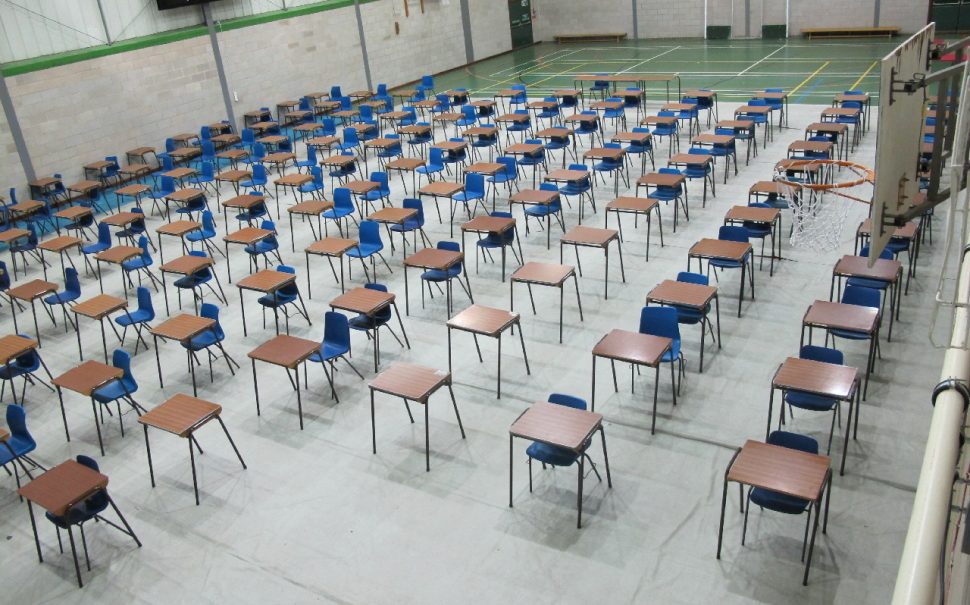
Featured image credit: Exam tables in sports hall, Epsom College by David Hawgood, via Wikimedia Commons under CC BY-SA 2.0 licence

Join the discussion