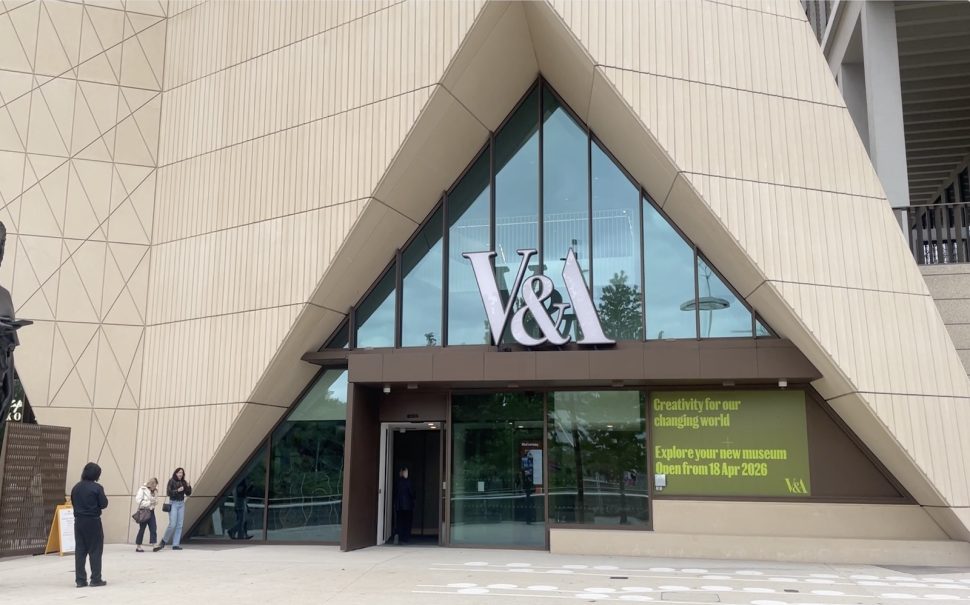
The newly-opened V&A East Museum in Hackney’s Queen Elizabeth Olympic Park has a “really encouraging level of engagement from young people”, the museum’s live programming curator has said.
Upon opening on 18 April, it has housed its inaugural exhibition, ‘The Music is Black: A British Story’, as well as the permanent ‘Why We Make’ galleries and ‘HEARD’, a sculpture installation by Turner Prize-nominated Rene Matić. Director Gus Casely-Hayford expressed the desire to make the museum a transitory space between the Young V&A and the South Kensington V&A, a place for young, “creatively-minded” people who may not feel at home in museums.
The first ‘back2back’ museum-wide takeover, held in collaboration with collectives Up Ya Archives and Rendezvous Projects, saw an encouraging level of engagement from young people, as live programming makes the museum an interactive and more welcoming space.
Rubén Salgado Pérez, Contemporary Programme Curator for Live Programming, said: “I think the response from young people has been shaped by the fact the programme does not feel overly formal.
“That matters because younger audiences often respond to spaces where they can decide how to engage, rather than being told how to behave or what kind of museum experience they should have.”
‘Back2back’ saw a whole day of events held across the Olympic Park, with talks, creative activities, and film screenings and more in the V&A East Storehouse before a discussion panel, a live DJ installation and even a quasi-rave in the V&A East Museum.
Salgado Perez spoke of how ‘back2back’ was designed to bring contemporary London into the space, echoing words from Casely-Hayford, who mentioned how local young people were consulted in the creation of the museum in order to make it a space “for them”.
Both ‘The Music is Black’ and ‘back2back’ heavily highlighted the east London locality of the museum, highlighting the area’s incredible impact on British music, from the Crossways Estate in Bow where grime legends Wiley and Dizzee Rascal both lived, to the Leyton home of Brian ‘Bizzy B’ Johnson, where he set up jungle label Brain Records.
Salgado Perez continued: “Rather than asking young people to simply come into the museum as visitors, the programme is interested in what happens when the museum becomes a site of exchange.
“The museum becomes a place where young people can hang out, participate, and encounter collections differently, hopefully seeing their own cultural references and creative networks reflected in the programme.”
Featured image credit: Abena Oppon
Join the discussion