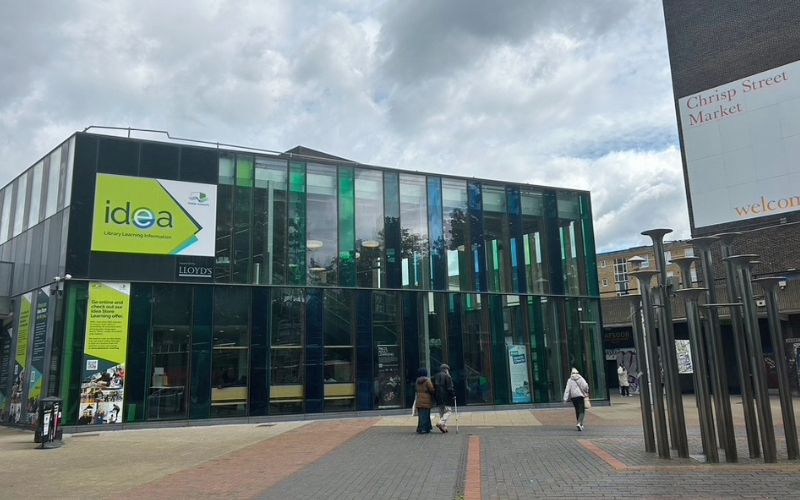
Book borrowing is on the decline across North East London, as library funding cuts and closures have swept the capital.
The number of books borrowed from libraries in Barking & Dagenham, Hackney, Havering, Newham, Redbridge, Tower Hamlets and Waltham Forest in 2025 was down 566,000 compared to three years previously, according to data accessed via Freedom of Information requests to local councils.
This 13% decline comes amid a national squeeze in library funding.
Council spending on libraries and culture dropped by £470 million between 2010 and 2024, according to the County Councils Network, and research by the BBC showed that 190 libraries closed across the UK in the five years preceding 2025 – including 20 in London alone.
James Gray, Communication and Advocacy Manager for Libraries Connected – a charity representing 176 library services across the UK – explained that while libraries are a statutory service, councils are allocating more funding to areas such as social care, SEND and transport.
He said: “It’s not just about the library buildings closing, it’s also about hidden cuts to opening hours, specialist staff, such as children’s librarians, and stock budgets.
“Some local authorities really prioritise libraries and see their value in trying to improve things like children’s and adult literacy, employability, health and wellbeing and digital literacy, and so invest in them.
“We’d like to see more local authorities making the decision to do that.”
Havering libraries have experienced particular hardship, recording the sharpest fall in book borrowing anywhere in London.*
The council shut three libraries – Gidea Park, Harold Wood and South Hornchurch – in 2025 in a bid to save an estimated £288,000 annually.
The decision was criticised by residents and opposition councillors alike, with former Conservative councillor David Taylor describing the decision in a Facebook post as “deeply, deeply, disappointing”.
The closures have significantly increased pressure on the borough’s remaining libraries and each branch now serves more than 39,000 residents – up by around 11,800 people per library – giving Havering the fifth highest resident-to-library ratio in London.
At the same time, annual borrowing figures in the borough dropped dramatically, from more than 940,000 books in 2022 to just over 561,000 in 2025 – a decline of 40%.
The pressures facing Havering reflect a wider strain on libraries across North East London, where resident-to-library ratios are among the highest in the capital.
Tower Hamlets has over 47,400 residents per library, the second-highest figure in London behind Brent, where there is one branch for every 58,800 people.
Yet, despite the potential strain on resources, libraries in Tower Hamlets are performing well.
It was the only borough in North East London where book borrowing increased between 2022 and 2025.
Book loans rose from around 650,000 in 2022 to just under 720,000 in 2025 – an increase of 11% and the sixth highest growth rate in the capital.*
The seven libraries across the borough are all part of the Idea Store service, a concept which launched in 1999 after the council saw users of public libraries drop to 18%, compared to 55% in the whole of the UK.
Idea Store aims to create true community hubs which seamlessly bring together library, learning and information services.
Each year, 7,000 people enrol on its programme of courses, ranging from practical classes such as English language and IT for business, to creative skills such as printmaking and African dance.
Sergio Dogliani, Head of Idea Store, said: “Particularly in Tower Hamlets, a lot of people drop out of education, they don’t tend to have proper qualifications and find themselves either jobless or with poorly paid jobs and they want to go back to education.
“By amalgamating the library and adult learning services, we’ve made it easier for people to access courses, step up and improve their quality of life.”
Dogliani added that social cohesion is another focus point for Tower Hamlets’ libraries.
He said: “We’ve created places that don’t belong to anyone, but belong to everyone – we always wanted to be places not just for avid readers.
“You only have to enter an Idea Store and you will see our customers and staff by-and-large mirror the community.
“If you have a very diverse community who come and use a space which is primarily staffed by people who are not from their community – whether that’s in terms of age or ethnicity – they feel they do not fit in, so we make sure our staff are all local people.”
Each Idea Store branch hosts a Story Time session for children under five, every morning Monday to Saturday.
Jasmine brings her two-year-old son to Story Time at Idea Store Chrisp Street once a week.
She said: “It’s a really nice place for babies – it’s free, it’s a nice thing to do in the morning and I’m trying to get my son more into books.
“Getting him comfortable with words and reading is really important, and it’s also been good for his socialisation.”
Tower Hamlets was also the only borough in North East London to record an increase in children’s book borrowing between 2022 and 2025.
However, this growth was modest at 1.8%, well below the borough’s overall increase in book loans.
Hackney was the worst-performing borough across all of London for children’s books, with a 22% decrease in titles borrowed since 2022.**
Gray explained that a decline in specialist children’s librarians has weakened libraries’ ability to offer services including book recommendations, reading for pleasure schemes and outreach work with schools and nurseries.
He said: “Children’s literacy and all the stuff that goes with it should be a joined up thing with lots of different people and organisations, and you really need specialist librarians to lead on that work.”
Children’s book borrowing across North East London has reduced by around 11%, however, children’s titles still account for a disproportionately large share of all books borrowed in every borough.
In Newham, for example, 70% of all books borrowed in 2025 were children’s titles, despite under-18s making up only 22% of the borough’s population.
Although borrowing figures have declined across the capital, London’s libraries continue to offer vital services to local communities.
Gray said: “So much of what libraries offer goes beyond traditional booklending service.
“They also promote digital inclusion, learning, and health and wellbeing – which has been a massive growth area.
“Libraries are great at having a big impact for not much money.”
*Data unavailable for Lewisham.
**Data unavailable for Haringey, Kingston upon Thames, Croydon and Lewisham.
Featured image credit: Alice Bathurst


Join the discussion