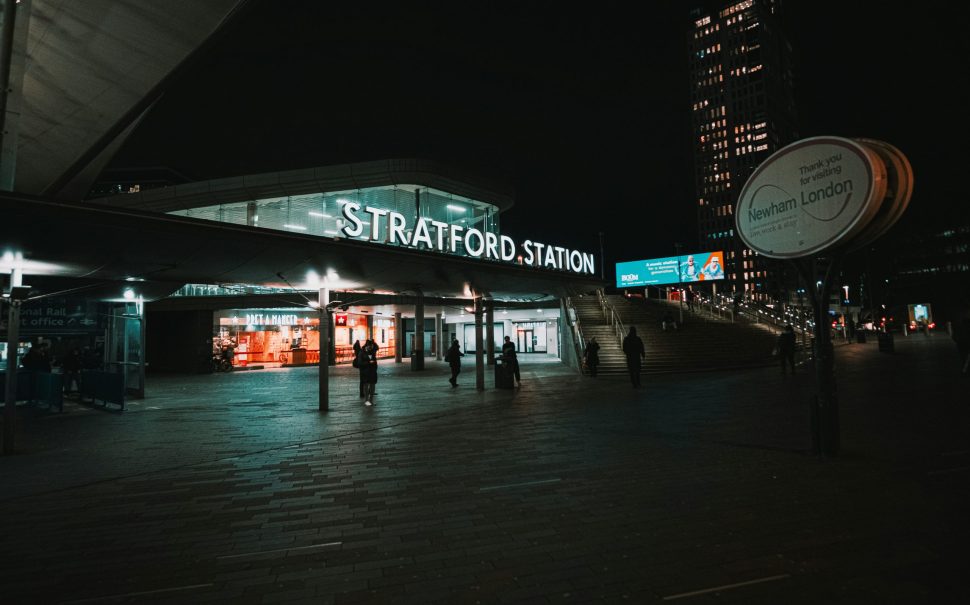
Residents in Newham claimed they feel unsafe, are seeing public spaces worsening and their support systems dwindling.
This comes as the borough remains the most deprived in London according to GOV.UK data, which ranked it the seventh most deprived area in the UK.
Victoria, a nurse from Canning Town, took her daughter to play in the park as she explained the impacts on the borough’s residents.
She said: “They used to have water fountains in the park and they had a nice sand pit. Now everything is broken, and nobody is fixing it.
“It’s not very safe. I go from the station, home, station, home – that’s it. It’s horrible, it’s dirty, and there’s lots of crime as well.”
The health worker relayed her closeness with her neighbourhood and local community, but expressed that she didn’t feel supported by the government.
Another anonymous resident claimed they had been robbed in the area.
When asked about youth clubs, they felt there was access, but run by people who don’t act.
They added: “I feel like we need regeneration. A lot of these houses are where a lot of poverty-stricken people are, so I feel like if it’s regenerated there will be a lot more access to youth centres and clubs, and I’d say it would be a lot better.”
The East London borough’s recent local elections shifted from Labour to no overall control, and saw the election of a new Labour mayor, Forhad Hussain, promising change.
Labour now has 26 councillors, a local independent group has 24 and the Green Party has 16 meaning cooperation between them will be key to the borough’s future.
A report released by Newham Council, quoted from Hussain’s acceptance speech.
It read: “The election matters because people deserve a choice. Democracy works when people are willing to step forward and serve. I start work next week with energy and determination to deliver for every part of the borough.
“This is the beginning of a new chapter for the borough. Together we will build a Newham where every resident will be proud to call home. It is the honour of my life to be elected Mayor of Newham, the borough that made me.”
Following a monumental win by the Greens, the leader of Newham Green Party, Nate Higgins, said: “This is going to be a completely different council.
“All of our councillors are elected off the back of incredibly hard work in their communities and we’ve seen that when Greens get elected, they stay elected.
“That’s because we work so hard to make things better, to be transparent and accessible, communicate with our residents and of course to make Newham a greener, cleaner, safer place.
“I think that’s what everyone in Newham wants and that’s what’s really shown in our election.”
What does the data show?
GOV.UK describes deprivation as lacking a high level of any kind of resource, not just finances and income, but also access to any factors that allow the population to meet their needs.
The rank of average rank data summarises and averages the hyper-focused local ranks to an average borough-wide rank, where the lower the number, the higher the deprivation level.
The deprivation data used was GOV.UK rank of average ranks for IMD in districts throughout England.
Trust for London released living ranking indicators mirroring high levels of deprivation in Newham, showing alarming numbers.
Figures show unemployment rates to be 8.7% compared to the average London numbers of 5.6% and the lowest in Westminster.
Newham’s unemployment rate has risen by a vast 2.3% since 2024, whilst Westminster has significantly dropped by 1.8%.
The extensive differences in the change of deprivation factors, such as employment levels, paint a picture of London’s worsening deprivation inequality, with the least deprived areas evolving and developing, and the least deprived areas remaining or worsening in conditions, as reflected by residents.
Poverty rates sit at 38%, with children living in poverty hitting 45%, both high above the London average.
The London-based charity recently released an IMD deep-dive into the underestimation of deprivation on the ground in London.
It considers the central features of IMD data and their direct relationship with poverty, the housing crisis, and deprivation, claiming that it is underestimated in how it is structured.
Their reports state: “The IMD is calculated by looking at seven different ‘domains’ – one of which includes housing. But it doesn’t weight them all equally.
“Health and education are both given a larger weighting than housing and barriers to services.
“London tends to perform better on those two domains – it has significantly better education outcomes than the rest of the country.
“On top of this, the housing and barriers to services measure has been criticised by organisations like London Councils because it underplays housing costs and the housing crisis.
“Distance to a post office, for example, carried the same level of importance as homelessness in previous editions of the IMD – though the latest edition took steps to rectify this.
“The impact of these factors is to obscure the true level of deprivation in London. This matters because the IMD is so widely used, including in decisions about where public money and money from charitable foundations goes.”
With residents unsatisfied with the worsening state of local communities in Newham, both on the ground and statistically, there is a clear need for change amongst locals – what the new council promises is adequate development.
The North East Londoner requested a comment from the council in response to the deprivation statistics, but they declined due to the appointment process of the newly elected council.
Feature Image Credit: Samuel Regan-Asante via Unsplash



Join the discussion