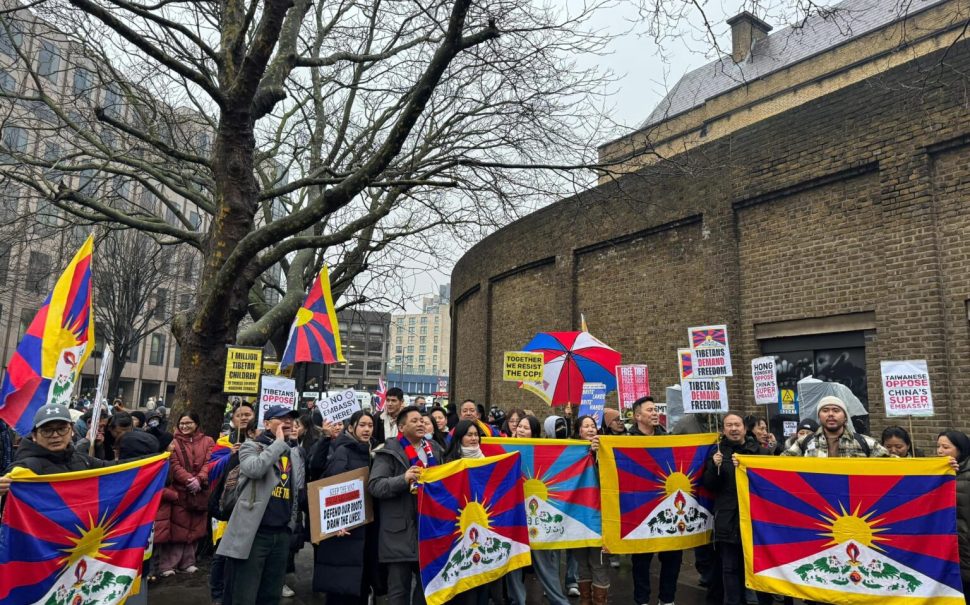
The former Royal Mint Court in Tower Hamlets has become a site of major geopolitical tension, as the Chinese government awaits planning approval to develop it into the biggest embassy in Europe.
At 20,000 square metres, the proposed complex would be the biggest embassy in Europe.
In 2022, Tower Hamlets unexpectedly refused to grant permission to the project, citing concerns about its impact on residents and the local area.
Shortly after Labour came to power, China resubmitted the application and raised the matter directly with Keir Starmer on their first call in August 2024.
Residents of Tower Hamlets, Tibetans, Hongkongers, Uyghurs, Taiwanese and Chinese nationals have staged numerous protests outside the embassy over the past year as the decision continues to be delayed.
Former Deputy Prime Minister Angela Rayner was expected to decide on the planning application on October 21, but it was pushed back to December 10.
Security Risks
The proposed embassy plans include a culture centre and housing for 200 staff, but large sections in the basement have been greyed out for “security reasons”.
The site was once wired directly into the UK’s financial infrastructure when it housed Barclays Bank’s trading floor, and a nearby tunnel has since 1985 carried fibre optic cables under the Thames, serving hundreds of firms.
Also on the grounds of the Court in the Wapping telephone exchange. There is concern that these fibre optic cables would allow China access to the UK’s financial system.
In response to the delay, Beijing’s Foreign Ministry Spokesman Lin Jian said: “Britain should fulfil its obligations and honour its commitments. Otherwise, the British side shall bear all consequences.”
Matt Western, the Labour MP who chairs the Joint Committee on the National Security Strategy, wrote in a letter to the government in October that approving the embassy was not in the UK’s long-term interest.
Western said the proposed location posed “eavesdropping risks in peacetime and sabotage risks in a crisis” owing to its proximity to fibre-optic cables, datacentres and telecoms exchanges serving Canary Wharf and the City.
According to a report in the Sunday Times, the White House warned against approving the embassy on similar grounds.
Transnational repression
Tenzin Rabga, Campaigns Officer at Free Tibet, explained that what he feared most was transnational repression.
He said: “They’ve already proven they can beat our civilians, our citizens inside their consulates.
“My fear with this mega embassy is that they would be left unchecked – they would be free to do monitoring surveillance around the UK, threatening and intimidating people.”
In 2022, a Hong Kong pro-democracy protester was dragged into the grounds of the Chinese consulate in Manchester by unidentified men and beaten.
British police then stepped over the boundary to rescue him.
Ragba said his freedom to speak out against the Chinese occupation of Tibet was in part due to his not having direct links with family in Tibet.
While many Tibetans in exile might be active in community events, they won’t come to protests or speak out because of the risk it could pose to their family inside Tibet.
Ragba added: “What the Chinese government tends to do is weaponise Visas for Tibetans. They’ll allow them access inside Tibet on the condition that they provide information on their community members.”
Embassies are privileged areas, meaning local authorities have no right to enter without official permission.
For Ragba, what is unprecedented is the size of the embassy and the redacted plans.
He said: “What makes the redacted embassy plans all the more ominous is that if they’re not even willing to tell the UK government what they’re planning to use the rooms for.
“It’s not just hysteria. We face violence back home in our communities, so if they were to bring this sort of violence here through the embassy, who’s to say people who are brought in will make it back out?”
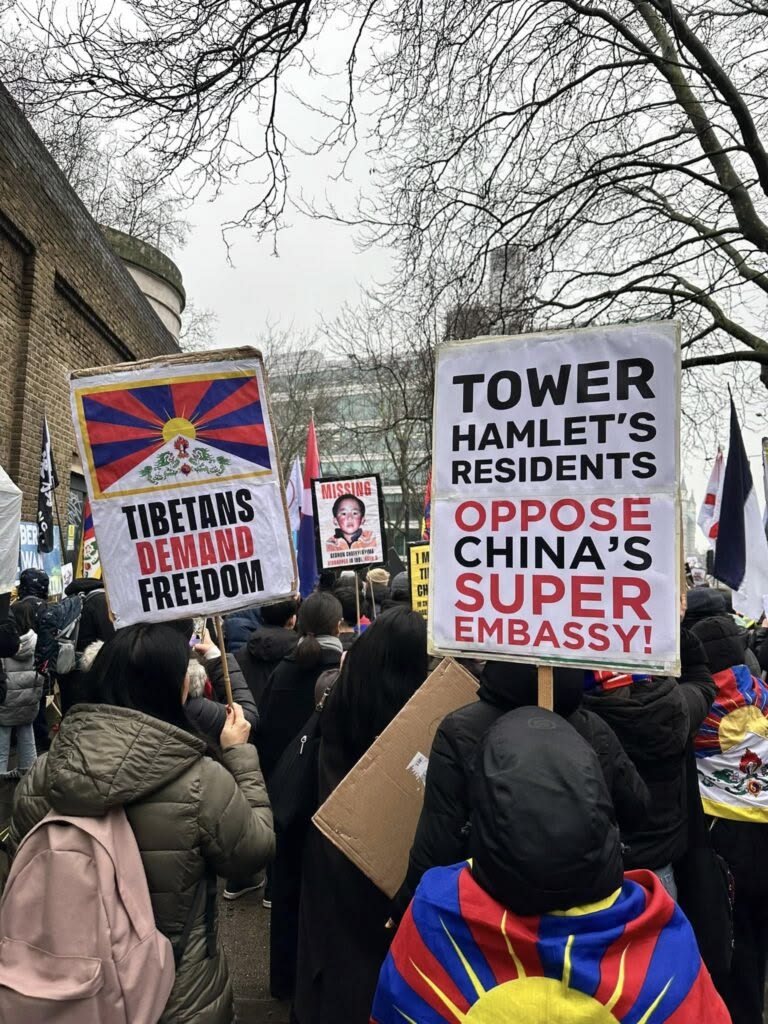
Campaign of Espionage
Norpell Wilberforce, a Tibetan youth organiser, believes it would give the Chinese government a massive operational basis from which to coordinate its various espionage campaigns in Britain.
In practice, it would drastically reduce his ability to organise and protest.
He’s experienced harassment previously. While organising Tibetan advocacy initiatives at university, he was accused of undermining “Chinese sovereignty” and of fostering separatism by Chinese students.
He said: “What’s presented as Chinese unity is really just Han ethnonationalism, which means that any criticism by ethnic minorities is dismissed as an attack on the Chinese nation.
He is concerned about the integration of Chinese software that would follow if the embassy plans go forward.
Wilberforce said: “If Chinese software is incorporated into British hardware, the risks of hacking, bugging and general espionage increase massively.
“This is happening parallel to Starmer’s government quietly trying to shut down the investigation into Chinese spies.
“There is no more concerning precedent than that.”
He said the embassy posed a threat not only to minorities under CCP oppression, but to all Chinese people living in the UK.
Cyber Threats
Carmen Lau, an exiled Hong Kong politician who now lives in the UK, said after she protested the mega-embassy in February, her family in Hong Kong was taken and intimidated by the National Security Police.
Lau was elected a district counsellor in 2019, but fled to the UK in 2021 after the government imposed a National Security Law, which mandated that all elected officials take an oath of loyalty to China.
Since fleeing Hong Kong four years ago, she has not been able to speak to her friends and family.
Lau said: “By fleeting, I was able to continue to speak up for Hong Kong freedom and democracy, and I see it as a reasonable compromise.”
In March, her neighbours received bounty letters from the Hong Kong police, offering 1 million Hong Kong dollars to anyone who would provide information or take her to the Chinese embassy.
Afterwards, she said she received a letter from Thames Valley Police requesting that she cease any activity likely to put her at risk and avoid public gatherings such as protests.
Thames Valley Police said: “As part of our routine approach to prevention, we also provide guidance on steps individuals can consider to enhance their personal safety.
“It is ultimately the choice of the individual whether or not they follow this advice.”
According to MI5, Hong Kong police have issued bounties against more than a dozen pro-democracy activists in the UK.
She’s been the target of numerous Chinese state-hacking attempts, an experience she says is common for Hong Kongers, foreign advocates, human rights experts, journalists and academic personnel.
She said the UK government’s decision to warm up relations with China has already caused a lot of disappointment and distrust from Hong Kongers, who fear they may not be protected in the face of transnational repression.
Lau said recent changes in immigration policy reflect a similar pattern.
She added: “I still have hope that the UK is a country under the rule of law, but I’m quite disappointed by the lack of answers in the dismissed Christopher Cash and Christopher Berry spy case.”
Trade with China
One factor in the negotiations is the trading relationship between the UK and China. In September, the Department for Business and Trade announced it would hold the first trade talks with China in seven years.
The newly appointed Business and Trade Secretary Peter Kyle said he would use the first UK-China Joint Economic and Trade Commission (JETCO) since 2018 to press British businesses to have greater access to the Chinese market.
The secretary is looking to secure deals worth over £1 billion over five years, part of delivering “Our Plan for Change.”
In September, the Director of Public Prosecutions controversially dropped charges under the Official Secrets Act of 1911 that accused former parliamentary researcher Christopher Cash and Christopher Berry of spying for China.
Since it was dropped, Keir Starmer’s Labour government has been accused by opponents of undermining the prosecution in seeking better economic ties with China.
The Chinese Embassy and Thames Valley Police were approached for comment.
Featured Image Credit: Tenzin Rabga


Join the discussion