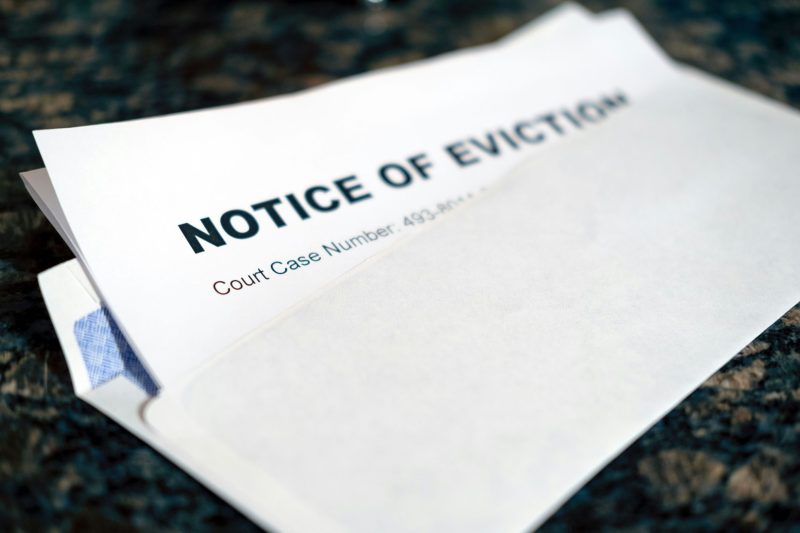
The London borough of Newham leads the capital for the most repossessions by county court bailiffs, with more than 7 recorded per 1,000 households, according to Trust for London.
Fellow north east London boroughs Barking and Dagenham (6 per 1,000 households) and Redbridge (5 per 1,000 households) also top the list, with most London boroughs seeing either a return to or a surpassing of their figures from before the pandemic.
The London average for repossessions, roughly 3 per 1,000 households, is more than double the figure recorded for the rest of England, which is just over 1 per 1,000 households.
This means Newham residents are on average more than three times as likely to have their home repossessed than those who live elsewhere within the capital city, and seven times more likely than the rest of the country.
Samir Jeraj, a journalist and author whose work focuses on housing issues, believes that gentrification may be to blame for the high number of repossessions.
He said: “Newham has high rates of poverty but it is also experiencing gentrification.
“Especially around the area of the Olympic village, those areas are becoming more expensive in housing terms.”
In regard to the high number of repossessions in Newham, Nye Jones, head of campaigns for renters’ campaign group Generation Rent, said: “The combination of really high rent and low incomes, which is most pronounced in Newham, creates poverty and destitution.”
Newham’s poverty rate of 38% is higher than the London average of 26%, with only three boroughs registering a worse figure for this statistic, while it’s child poverty rate – 45% – ranks amongst the worst in London, surpassed only by Tower Hamlets and Hackney.
Newham also ranks amongst the worst boroughs in London for income deprivation, with the average neighbourhood in the borough being almost twice as income-deprived than the rest of the country, and just less twice as income-deprived than the rest of the capital.
Jones said that the Renters’ Rights Act will be a vital first step for renters, but remains cautiously optimistic.
He said: “It will go a long way to address the power imbalance between renters and landlords, and the abolition of Section 21 evictions will hopefully significantly reduce the number of evictions.
“But it doesn’t address the cost of renting and so people will still have issues finding somewhere affordable to rent.
“If people are evicted, often through no fault of their own, they often can’t find somewhere else affordable to live.”
According to Newham’s Temporary Accommodation Task and Finish Group Report, published in July, the high number of repossessions has also put severe pressure on the borough’s supply of temporary accommodation.
Jeraj agrees that the new Renters’ Rights Act is an improvement on the current situation, but believes that enforcement may prove to be a challenge.
He said: “It is a huge step forward, but enforcement will be a challenge as it is largely down to poorly resourced local councils.
“There is also concern that landlords will make use of the remaining months of no fault evictions to clear people out in order to get people in on higher rent.”
There are 17 London boroughs currently observing evictions occurring at either the same rate or more frequently as they did before the pandemic.
Newham and Barking and Dagenham had the highest rates of repossessions before the pandemic, with both boroughs having roughly 4 repossessions per 1,000 each in 2019, according to Trust for London.
Newham also ranked third out of all London boroughs for the most residents earning below the London living wage in 2024, at just below 24%.
The London boroughs with the lowest rates of repossessions were Kensington and Chelsea (0.7 per 1,000 households) and Richmond-upon-Thames (0.8 per 1,000 households) each had the lowest rates of evictions, with Richmond-upon-Thames also having the lowest rates before the pandemic.
Only the London boroughs of Islington, Camden, Hammersmith and Fulham, Richmond upon Thames, and Kensington and Chelsea recorded a lower repossession rate than the average for the rest of England.
According to Trust for London, 26% of Londoners, and 38% of those living in non-white households in the capital, are living in poverty.
Newham Council were approached for comment.
Featured image credit: Unsplash



Join the discussion