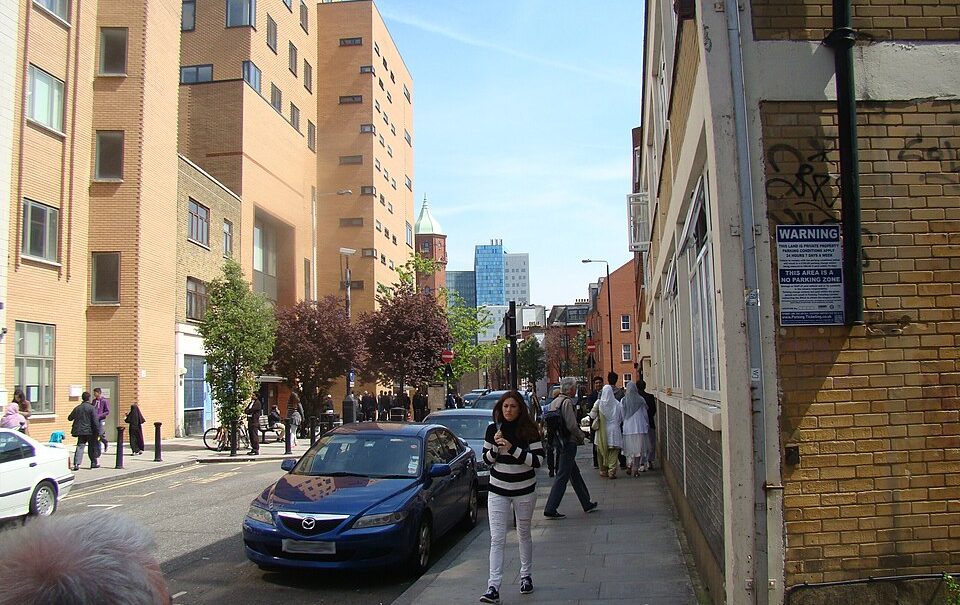
Parking fines on a narrow residential street behind the East London Mosque in Whitechapel have risen tenfold since 2021, generating more than half a million pounds in penalties.
Penalty Charge Notices (PCNs) on Fieldgate Street, which runs directly behind one of the largest mosques in Western Europe, rose from 195 in 2021 to more than 2,000 in 2024, data obtained through a Freedom of Information request shows.
Combined with two neighbouring streets, New Road and Plumbers Row, the three roads surrounding the mosque have generated more than £1 million in fines since 2019.
The surge follows a significant increase in enforcement officers deployed to the area and changes to the road’s layout.
These are measures residents say were desperately needed to tackle years of parking chaos, but which worshippers say have left them with nowhere to go and raises the question of whether one of east London’s most visited institutions is badly in need of dedicated parking.
“Before they made the changes, it was a nightmare – cars parked on both sides, you couldn’t get through.” said Shannon McGee, who lives in the area.
Tower Hamlets Council confirmed that a new one-way system was introduced on Fieldgate Street on an experimental basis on 29 February 2024 and was made permanent in August 2025.
A further scheme the same month added double yellow lines and “No Loading at Any Time” restrictions at key junctions.
Both schemes, a council spokesperson said, were advertised for public consultation in line with statutory processes.
But the street’s record year for fines – 2,081 in 2024, with March alone producing 368, the highest single month on Fieldgate Street in the entire dataset – came while the new road layout was still experimental.
Drivers who had used the street for years were navigating restrictions that had not existed weeks earlier, and would not be confirmed as permanent for another 18 months.
Ali, who lives on Myrdle Street just off Fieldgate Street, says the impact on residents has been significant.
“If I move my car during prayer times I’m not getting that spot back,” he said. “I understand it, the mosque has so many people coming, but it’s us residents who face the difficulties.
“If I leave for work in the morning I just know my spot will be taken. People don’t care about getting tickets, they’ll leave the car there for five minutes while they go and pray.”
For the worshippers who travel to the mosque from across London, many from areas where direct public transport links to Whitechapel are limited, the experience has been very different.
Abidur Rahman travels from Islington every Friday for Jumu’ah (Friday) prayers.
He explained that driving is faster than the train, but finding somewhere to park has become a journey of its own.
He said: “The one-way system just means you end up going round and round. You can see a space but you can’t reach it.
“This is one of the biggest mosques in Western Europe and the road behind it is basically one lane. It doesn’t make sense.”
It is not just regular worshippers who feel it.
Hanad Jama, who travelled to Whitechapel from outside Tower Hamlets to eat and pray, found the same problem.
“We parked at the Sainsbury’s which is quite a walk away, there’s about 90 minutes of free parking but that’s the best you can do around here,” he said.
“This is such a central part of east London and the parking is so bad. The roads are tiny and all one-way so you can’t get anywhere close. We ended up doing a 20-minute walk just to find somewhere decent.”
The mosque complex, which includes the nine-storey Maryam Centre directly on Fieldgate Street, draws thousands of worshippers for Friday prayers and tens of thousands during Ramadan and Eid.
Its own website acknowledges the pressure plainly, warning that roadside parking is “extremely limited” and advising worshippers not to drive.
Asked about the enforcement data, the East London Mosque said: “The East London Mosque regularly reminds worshippers and visitors to park responsibly, respect local residents and businesses, and avoid causing obstruction on surrounding streets.
“Fieldgate Street can become congested during busy periods, particularly around Jumu’ah, Ramadan and Eid, and we continue to encourage our congregation to use public transport where possible and follow parking rules to avoid unnecessary fines.
“Parking enforcement is a matter for the local authority, and we maintain a constructive working relationship with Tower Hamlets Council and local partners to help manage busy community periods safely and responsibly.”
A Tower Hamlets Council spokesperson claimed the rise in fines reflects a genuine and growing problem, attributing it to the area’s expanding nighttime economy rather than any single cause.
They said: “Increased numbers of visitors to restaurants in the area and venues open in the evenings have significantly intensified activity levels and placed greater demand on limited kerbside space.
“Instances of non-compliant parking have become more prevalent, particularly during evening and late-night periods.
“Fieldgate Street and the surrounding area have benefited from informal and operational parking relaxations during key periods of religious observance, including Friday (Jumu’ah) prayers and Ramadan.
“Providing flexibility to religious venues during significant festivals is standard practice across the borough.”
The monthly figures, however, show fines continuing to be issued in large numbers during those same periods.
In March 2024, when Ramadan began on 10 March, Fieldgate Street recorded its highest single month in the six-year dataset – 368 fines.
In 2025, Ramadan began on 28 February but fell almost entirely across the month of March.
Fieldgate Street recorded 365 fines that month, marginally lower than the year before, but across all three streets combined, March 2025 produced 732 fines, the highest single month in the entire seven-year dataset.
The council strongly disputes any connection.
The spokesperson said: “It would be categorically untrue to claim that enforcement activity is consistently higher during Ramadan-related periods.
“Any observed increases are more appropriately attributed to operational changes and wider demand pressures.”
What the relaxations consist of, how worshippers are made aware of them, and why record fine volumes have coincided with the periods when they are said to be in operation, the council did not specify.
Alom Rahman, who had just attended prayers at the mosque, says enforcement alone will never be the answer.
“Getting to prayers on time comes first,” he said. “People aren’t thinking about tickets when they’re trying to get into the mosque. That’s just not the priority. Enforcement doesn’t really work. It doesn’t stop anyone coming.”
The council says fines on Fieldgate Street have since dropped – 1,884 in 2025, down from 2,081 in 2024.
But across all three streets combined, total fines rose 12% in the same year, from 3,589 to 4,026.
Plumbers Row, the next road along, saw a near 50% surge, from 1,163 fines in 2024 to 1,741 in 2025, suggesting enforcement pressure may have shifted rather than eased.
The borough-wide picture adds further context.
Two thirds of Tower Hamlets households have no access to a car – one of the lowest rates in England.
The people most likely to be parked on Fieldgate Street then, are not those who live on it. They are visitors: diners and worshippers.
The three streets around the mosque produced roughly one in every 36 of all parking fines issued across the entire borough in 2024, from three roads in one corner of one ward.
Residents have raised the prospect of new parking facilities and whether that could help ease the situation.
“If there was a proper car park nearby I’d use it every week, I’d happily pay,” said Rahman.
“Right now I’m either paying fines or wasting two hours of my Friday morning. Neither is a solution. This mosque serves thousands of people. It deserves better than this.”
McGee, despite welcoming the enforcement, believes the problem has not been solved.
She said: “You can’t just keep fining people and call it sorted. They need somewhere to go and we just can’t keep having it be roads that kids walk on and families live on.”
Featured Image credit: Robert Lamb via Geograph


Join the discussion